
Stowers scientists identify the fusion point of Robertsonian chromosomes, hinting at how chromosomes evolve
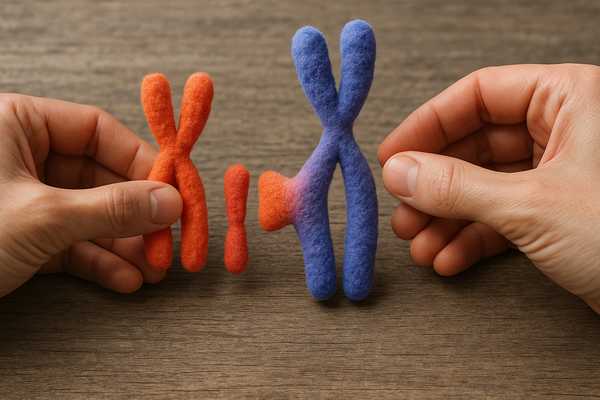
Stowers scientists identify the fusion point of Robertsonian chromosomes, hinting at how chromosomes evolve
News provided by Stowers Institute for Medical Research — Sept. 24, 2025
Robertsonian chromosomes are associated with infertility and Down syndrome; long-read DNA sequencing has produced the first comprehensive picture of their genetic rearrangements.
KANSAS CITY, Mo., Sept. 24, 2025 — Open a high school biology textbook and you’ll see human chromosomes lined up two by two, like socks in a drawer. But in about one in 800 people, two chromosomes fuse together to form Robertsonian chromosomes. That long-standing mystery has now been resolved in detail.
Scientists at the Stowers Institute for Medical Research have identified the precise DNA breakpoint where human chromosomes break and recombine to form Robertsonian chromosomes. Led by postdoctoral research associate Leonardo Gomes de Lima, Ph.D., and published in Nature on September 24, 2025, the study explains how these rearrangements form, why they can be stable, and suggests that repetitive DNA once dismissed as “junk” may play an important role in genome organization and evolution.

“This is the first time anyone has shown where this exact DNA breakpoint occurs,” said Jennifer Gerton, Ph.D., a lead author on the study and Stowers Institute Investigator and Dean of the Graduate School. “It opens the door to understanding how chromosomes evolve in a way that we had no appreciation for before.”
Carriers of Robertsonian chromosomes are often unaware they are different. Though generally healthy, carriers can experience infertility or miscarriages and are at increased risk of having a child with Down syndrome.
The team used long-read DNA sequencing to produce the first complete sequences of Robertsonian chromosomes. Long-read technologies, which became transformative for genome assembly in 2022, allow scientists to read repetitive DNA sequences that earlier methods could not resolve.
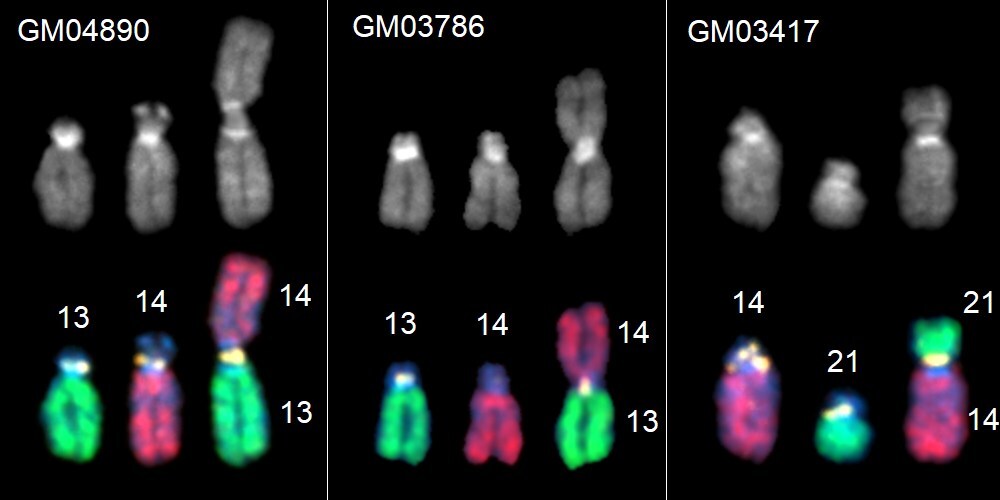
Comparing sequences from three human Robertsonian chromosomes with their normal counterparts, the researchers found a common breakpoint in a specific repetitive DNA sequence called SST1. “That’s never been shown before — in humans or any other species,” Gerton said.
Genome scientist Glennis Logsdon, Ph.D., of the University of Pennsylvania, who was not involved in the work, called the study a “landmark” and said that identifying the precise breakpoint could ignite a broader understanding of how these chromosomes function.
Gerton emphasized that the project benefited from collaboration. The work was done in partnership with Adam Phillippy, Ph.D., at the National Human Genome Research Institute and Erik Garrison, Ph.D., at the University of Tennessee Health Science Center, bringing together complementary expertise in genome assembly, population variation, and repetitive DNA biology.
The fusion formula
The team found that highly repetitive SST1 sequences are the sites where breakpoints occur. When SST1 sites come together inside the nucleolus, their proximity can promote a merger that produces a Robertsonian chromosome. These repeats sit near centromeres — the central chromosome regions — and are especially common on acrocentric chromosomes, the five chromosome pairs with very short arms.
Robertsonian chromosomes form when the two long arms of acrocentric chromosomes fuse and the short arms are lost, leaving 45 chromosomes instead of the usual 46. That change can interfere with proper segregation during reproduction and contribute to infertility.
The study also explains why fused chromosomes can remain stable: although fused chromosomes carry two centromeres, usually only one is active, preventing the fused chromosome from being pulled apart in opposite directions during cell division.
Looking across species
Robertsonian chromosomes are found across animals and plants and were first described in grasshoppers. The researchers examined genomes of humans’ closest relatives, chimpanzees and bonobos, and observed that while SST1 sequences exist in great apes, their arrangement differs from humans, suggesting a human-specific configuration in these cases.
“It really got us thinking about the role these repetitive DNA sequences play in shaping the genome and potentially creating new species,” said Leonardo Gomes de Lima. “It’s clear that there’s a story there, and that’s what we plan to study next,” added Gerton.
Additional authors include Andrea Guarracino, Ph.D.; Sergey Koren, Ph.D.; Tamara Potapova, Ph.D.; Sean McKinney, Ph.D.; Arang Rhie, Ph.D.; Steven Solar, M.D.; Chris Seidel, Ph.D.; Brandon Fagen; Brian Walenz; Gerard Bouffard, Ph.D.; Shelise Brooks; Michael Peterson; Kate Hall; Juyun Crawford; Alice Young, Ph.D.; Brandon Pickett, Ph.D.; Erik Garrison, Ph.D.; and Adam Phillippy, Ph.D.
The work was funded by the National Cancer Institute of the NIH (R01CA266339), the National Human Genome Research Institute of the NIH (R01HG013017), the National Institute on Drug Abuse of the NIH (U01DA057530), the Division of Computing and Communication Research of the National Science Foundation (2118743), the Intramural Research Program of the National Human Genome Research Institute, the State of Tennessee’s Center for Integrative and Translational Genomics, and institutional support from the Stowers Institute for Medical Research. The content is solely the responsibility of the authors and does not necessarily represent the official views of the NIH.
About the Stowers Institute for Medical Research
Founded in 1994 through the generosity of Jim Stowers and his wife Virginia, the Stowers Institute for Medical Research is a nonprofit biomedical research organization focused on foundational research. The Institute’s mission is to expand understanding of the secrets of life and improve quality of life through innovative approaches to disease causes, treatment, and prevention. The Institute comprises 20 independent research programs and roughly 500 members, including more than 370 scientific staff. Learn more at www.stowers.org and about its graduate program at www.stowers.org/gradschool.
Media contact:
Joe Chiodo, Director of Communications
724.462.8529
[email protected]
Source: Stowers Institute for Medical Research